
Homeschooling is the greatest defense we have against totalitarianism. If the State controls the children, the State controls the future.
tl;dr >>
-
Every totalitarian regime (left or right) makes homeschooling illegal and implements compulsory public schooling.
-
The goal is not to educate, the goal is to indoctrinate.
-
The would-be totalitarian cannot truly have total control if parents are free to educate their children as they see fit.
-
Hitler and the Nazis made homeschooling illegal so they could indoctrinate the German youth. Homeschooling is still illegal in Germany today.
-
If you think homeschooling should be illegal, you are literally in agreement with Hitler and the Nazis.
-
I was homeschooled and then attended public high school. I can speak to both. Homeschooling is a better option unless you enjoy giving control of your children to the government.
-
I am NOT bashing teachers. Individual teachers are not the problem (although obviously some of them are). The problem is the system itself.
-
If you send your kids to public school they will spend more of their waking hours in the control of the State than in your control.
-
Someone is going to indoctrinate your kids. Do you want it to be the State, or do you want it to be YOU?
“Homeschooling should be illegal.”
Maybe it’s just me (and what the algorithm decides to feed me), but I’ve noticed a lot of posts going around recently that are decidedly anti-homeschooling. Some even going so far as to literally say“homeschooling should be illegal.”
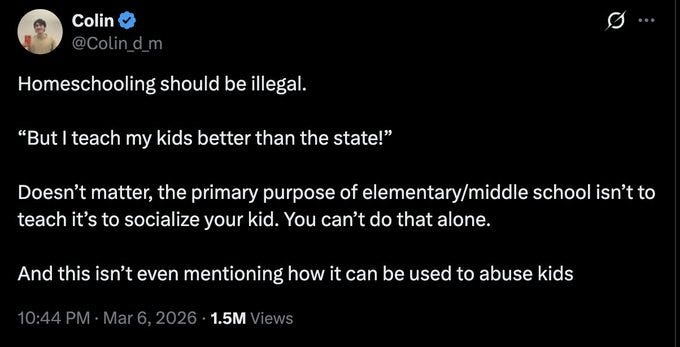
Mid-curve statist thinks he knows better than you do what is good for your kids.
This particular post drove me to write this article, but I’ve seen countless more in a similar vein. The reason the above post really stuck out to me is because it’s a classic example of “saying the quiet part out loud.”
This guy admits that it’s not about whether parents can teach their kids better than the state (they can); he doesn’t try to argue on that front. Instead, he says “the primary purpose of elementary/middle school isn’t to teach it’s to socialize your kid.“
Read that again... *“the primary purpose of elementary/middle school ****isn’t to teach ****it’s to *socialize your kid.”
On the surface, perhaps it seems rather innocuous. After all, the main critique that mid-curve statists throw at homeschooling is “your child won’t have friends! How will they meet other kids and socialize?!”
This is of course absurd and idiotic, and I’ll explain why later on for any mid-curvers who happen to have stumbled across this article. But first, I want to talk about why the statement “Homeschooling should be illegal” is truly evil, and why you should reject this idea at every turn.
First, let’s get a two things straight:
-
YOU love your children more than anyone else ever possibly could. YOU want what is best for your children more than anyone else every possibly could.
-
The State cannot love your children. The State does not want what is best for your children. The State cannot “want.” The State is a collection of people, and none of them love your children or want what is best for them more than you do.
Here’s the thing: the goal of compulsory public education is not education. The goal of compulsory public education is indoctrination.
The statist whose tweet I showed above admitted this: *the primary purpose of elementary/middle school ****isn’t to teach ****it’s to *socialize your kid.”
But when he says “socialize” what he really means is indoctrinate, program, and control.
Children are, quite literally, the future. When the State controls the children, the State controls the future.
Anyone who tells you that you are not qualified to teach your children or that they would be better off under the control of the State does not have your best interests at heart.
This is why every totalitarian regime, from the Communists to the Fascists and everyone in between, hated homeschooling and made it illegal.
Totalitarians Hate Homeschooling
Totalitarian regimes understood a simple truth: control the children and you control the future.
That’s why Nazis hated homeschooling. Communists hated homeschooling. Fascists hated homeschooling. Francoists hated homeschooling. Socialists hated homeschooling. Maoists hated homeschooling. Yes, there is some overlap in some of these but you get the point.
Any regime that demands absolute loyalty to the State/Party views parental education as a direct threat because it breaks the State’s monopoly on thought. Compulsory public schooling and mandatory attendance at state-approved institutions is the weapon totalitarians use to crush independent thinking and enforce ideological conformity. After all, people who think independently tend to ask a lot of questions, and one must never question The Party.
They also use it to create a dutiful little network of youthful spies within the home who are taught that ratting out their own parents for Wrongthink is the right thing to do.
By the way, this isn’t just Orwellian fiction. Talk to literally anyone who survived communism and they will tell you this, as my wife’s family told me.
Homeschooling allows families to raise their children free from State indoctrination, something totalitarians cannot tolerate.
But where did the totalitarians get this idea for compulsory public schooling in the first place? Enter Prussia.
NOTE*: If you don’t care about the history behind compulsory public schooling you can scroll down to the bottom to read my comments on common critiques I see of homeschooling. But I hope you will look into the history, because it helps us to understand the present.*
Prussia: The Blueprint
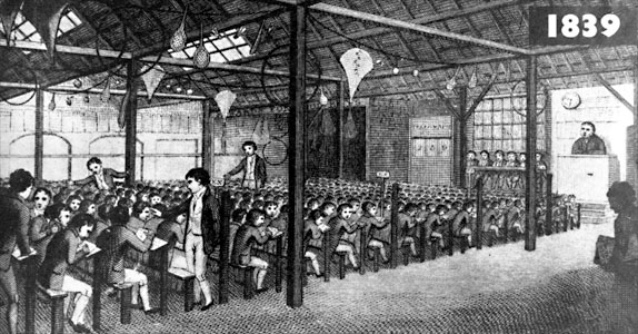
The modern system of compulsory public schooling began in absolutist Prussia. In 1717, Frederick William I (the “Soldier King”) issued a nationwide compulsory attendance decree. He required children (ages 5–12) to attend existing schools where available, motivated by a mix of Pietist Protestant influences (emphasizing religious instruction, discipline, and obedience to authority) and practical state-building needs. The goal was to create loyal, God-fearing, and obedient subjects who could support the growing Prussian military-bureaucratic state and strengthen royal control over the population (shifting influence away from the nobility and church toward the crown). Enforcement was spotty, and many areas lacked schools.
His son, Frederick the Great, expanded this in 1763 with the Generallandschulreglement (a massive mouthful that means “General School Ordinance”). Written with input from educator Johann Julius Hecker, it mandated attendance for children ages 5–14 at municipality-funded schools for boys and girls, professionalized teachers, set curricula, and aimed to cultivate knowledge, discipline, ethics, and loyalty to the state. They also claimed they wanted to promote “true welfare” after the Seven Years’ War (1756–1763, which Prussia survived but at huge cost), address rural illiteracy, and support military needs (e.g., literate officers and recruits). Ultimately, the goal was to create a more obedient populace that was easier to control.
Even so, at this point it still could have been a lot worse, relatively speaking. Then Prussia got their asses kicked by Napoleon in 1806 at the Battles of Jena and Auerstedt.
Prussia’s professional army was routed by Napoleon’s revolutionary forces (citizen-soldiers motivated by ideology and mass mobilization, not just drilled obedience). The Prussian kingdom nearly collapsed: Berlin fell, territory was halved by the Treaty of Tilsit (1807), and Prussia became a French vassal state temporarily.
Prussian reformers (e.g., philosophers like Johann Gottlieb Fichte in his “Addresses to the German Nation,” and officials like Wilhelm von Humboldt) blamed the loss partly on a lack of national cohesion, patriotism, sacrifice, and educated, loyal citizens. They argued the old army relied on rigid obedience without deeper commitment, while France’s levée en masse showed the power of ideologically motivated masses.
This led to sweeping Prussian Reforms (1807–1819), including major education “upgrades”:
-
In 1809–1810, Humboldt (as education minister) reformed the system toward universal, compulsory primary education (Volksschule), emphasizing broad knowledge (Bildung), moral/religious regeneration, national feeling, and critical thinking. All with the ultimate goal of serving state loyalty.
-
The system became more centralized, tax-funded, and enforced, aiming to produce disciplined, patriotic citizens who would never again fail the nation (including better, more obedient soldiers).
-
By the 1830s–1840s, it was fully compulsory and influential worldwide (including inspiring U.S. public schooling models via Horace Mann and others).
The Prussian model of a state monopoly over education became the template for totalitarian regimes worldwide in the century to come.
Germany: Nazis Hate Homeschooling
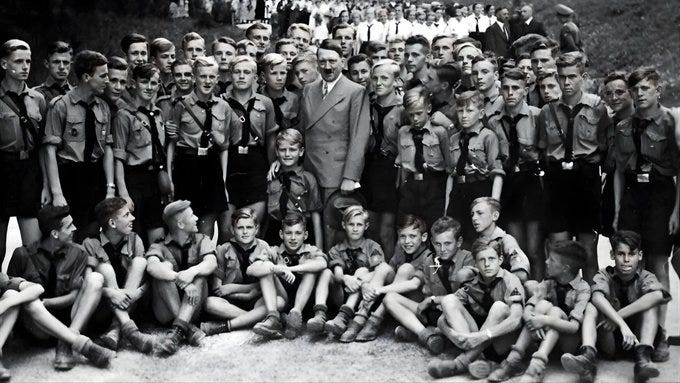
“The youth of today is ever the people of tomorrow. For this reason we have set before ourselves the task of inoculating our youth with the spirit of this community of the people at a very early age.” - Adolf Hitler
The Nazis took Prussian compulsion to its logical extreme. In 1938, they enacted the Reichsschulpflichtgesetz (another massive mouthful meaning “Law on Compulsory Schooling in the German Reich”), mandating attendance at state-approved schools “in the spirit of National Socialism.” Homeschooling and private exemptions were outlawed outright. Fully illegal. No exceptions for parental beliefs.
Prior to the 1938 Reichsschulpflichtgesetz, Hitler made his goals clear regarding the German youth. In a 1935 speech at the Nazi Party rally (Reichsparteitag) in Nuremberg, while promoting the importance of the Hitler Youth movement, Hitler said “He alone who owns the Youth gains the Future.”
The Nazis wanted to eliminate any alternative source of values, ensuring every child absorbed racial ideology, militarism, and fanatical loyalty to Hitler. Nazis hated homeschooling because it let families preserve independent thought and resist the regime’s total claim on youth. Violators faced fines, police raids, or worse.
Of course, after the Nazis were ultimately defeated, the Germans rejected and abolished all traces of Nazism, right? Wrong.
It is still illegal to homeschool your children in Germany TODAY... In 2026...
So Germany banned the swastika, but kept one of the most core laws instituted by the Nazis.
One can’t help but wonder why Germany would keep homeschooling illegal, carrying forward this evil Nazi law...
Italy: Fascists Hate Homeschooling
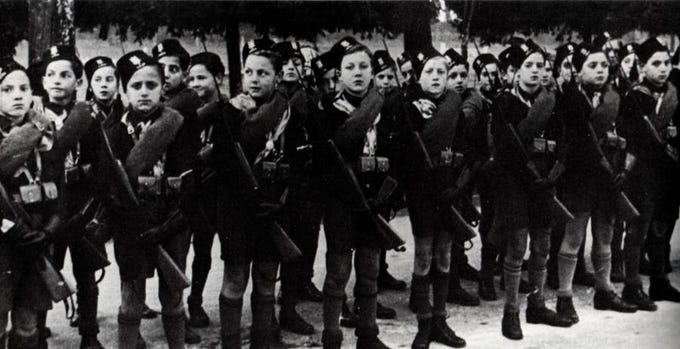
Benito Mussolini’s fascist regime centralized education and made it compulsory to mold fascist youth. Reforms in the 1920s required attendance at state schools, reinforced by mandatory youth organizations like the Balilla. Mussolini used compulsory public education as a totalitarian tool to create a “new Fascist man” and woman. The goal was to foster blind obedience to the State. Teachers swore loyalty oaths to fascism; a single state textbook spread propaganda. Homeschooling and private alternatives were suppressed because fascists hated anything that allowed families to teach values outside the regime’s nationalism, militarism, and obedience. The State claimed primacy over parents. The fascists believed children belonged to the nation, not the parents.
In the words of Mussolini himself: “Everything in the State, nothing outside the State, nothing against the State”
Yet again, the goal was not education. The goal was indoctrination.
Maoist China: Communists Hate Homeschooling
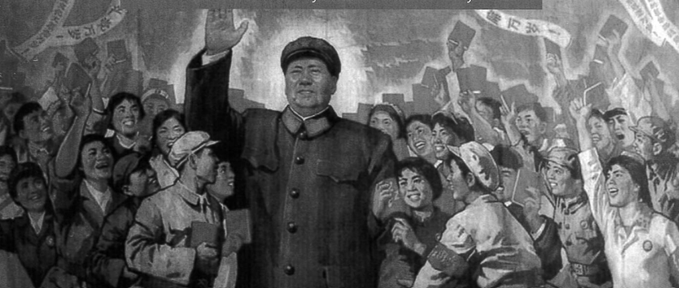
In Maoist China, the Communist Party under Mao Zedong maintained absolute, mandatory control over the ideological formation and “education” of youth. This absolute control persisted even when the traditional classroom-based compulsory schooling model was disrupted or suspended. From 1949 to the mid-1960s, Mao’s regime expanded universal, state-run schooling that was effectively compulsory, free, and secular. It was heavily infused with Marxist-Leninist ideology, Mao Zedong Thought, class struggle, atheism, and collectivism. Private education and homeschooling were banned as reactionary or bourgeois, ensuring no alternative influences could compete with the Party’s monopoly on shaping young minds. The goal was identical to other totalitarian systems: make children loyal to the State and the Party, instead of to their family.
Things changed during the Cultural Revolution (1966–1976), when formal schooling largely collapsed. Schools closed nationwide, teachers were persecuted as “bourgeois authorities,” academic standards were abandoned, and entrance exams eliminated. Even so, the Party never relinquished control of “education.” It simply shifted the mechanism of mandatory indoctrination to radical “re-education” programs. The most prominent was the Down to the Countryside Movement, which forcibly relocated roughly 17 million urban “educated youth” to rural communes for labor, political study sessions, and remolding by peasants. Participation was mandatory and refusal meant persecution. Ultimately, it served the same purpose as compulsory public schooling in other totalitarian regimes: enforce ideological conformity, break “counter-revolutionary” influences from family or urban life, and forge the “New Socialist Person.” It may have looked a bit different than the more structured programs of Nazi Germany or the early USSR, but the authoritarian intent and result were the same: the State/Party claimed exclusive ownership over education and youth indoctrination, and parents were invited to kindly pound sand.
As with Germany, homeschooling is still illegal in China today. The 1986 Compulsory Education Law (and subsequent stricter policies) requires nine years of schooling at state-recognized schools.
Castro’s Cuba: Communists Hate Homeschooling
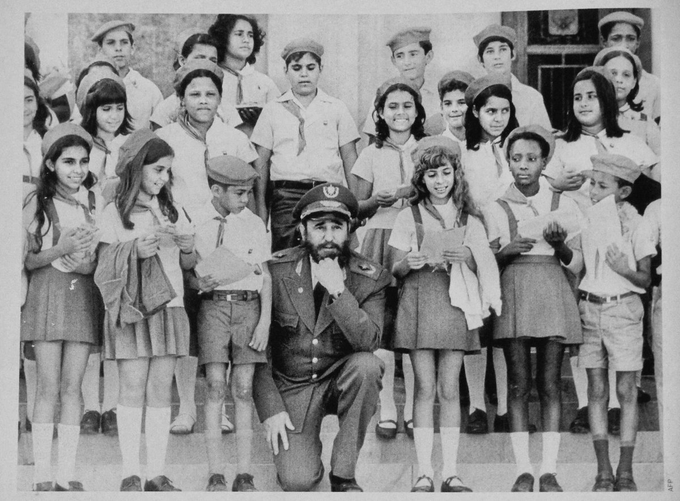
Fidel Castro nationalized all education, making it compulsory and free while banning private options. The 1961 Literacy Campaign mobilized over 250,000 volunteers, mostly young women, to eradicate illiteracy in just eight months, reducing rates from 23.6% to 3.9% through brigades teaching in rural areas. Curriculum pushed anti-imperialism and revolutionary values. Doesn’t sound too bad I guess, except for the fact that Cuba is still a communist shithole to this day and everyone tries to flee from Cuba to America... Communism has maintained it’s hold on Cuba because the communists controlled Cuba’s children.
Communists in Cuba hated homeschooling because it allowed families to resist state ideology and preserve individual or religious beliefs.
Soviet Union: Communists Hate Homeschooling
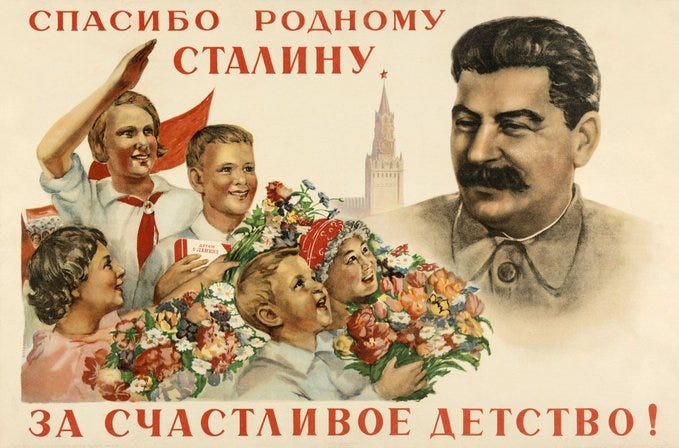
“Education is a weapon whose effects depend on who holds it in his hands and at whom it is aimed.” - Joseph Stalin
From Lenin to Stalin, the USSR made education universally compulsory and state-exclusive. Private or home-based alternatives were banned as bourgeois relics. The 1918 Decree on the Unified Labor School established free, co-educational, secular schooling divided into levels for ages 8–17, marking the start of mandatory attendance to promote communist values. Schools drilled Marxist-Leninist ideology, atheism, and collectivism. The goal was to create loyal communists stripped of family or religious influence. Communists hated homeschooling because it preserved “reactionary” parental values and undermined the party’s monopoly on shaping the “New Soviet Man.”
But hey, at least illiteracy was mostly eradicated. All it took was the complete destruction of freedom, a massive death toll, and countless years of suffering.
Spain: Francoists Hate Homeschooling
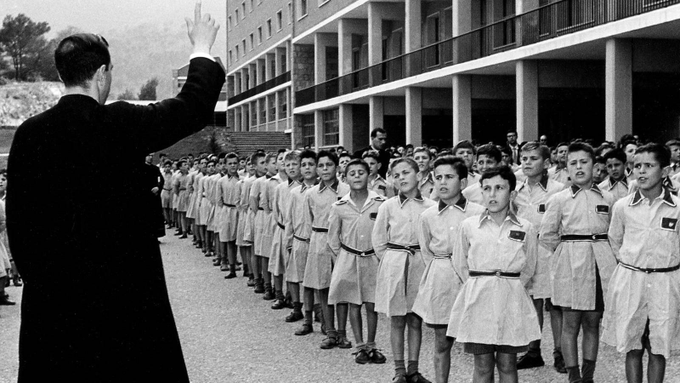
Francisco Franco’s dictatorship enforced compulsory education laced with Catholic authoritarianism and Spanish nationalism. In contrast to the communists, in Francoist Spain religion was mandatory. Curricula suppressed regional languages and identities while promoting anti-communism and Francoist loyalty. Homeschooling was effectively impossible under tight state control. But the Franco regime went even further... They systematically identified, separated, and removed children from families deemed politically, ideologically, or morally “undesirable” (primarily Republicans/”Reds,” political prisoners, executed opponents, exiles, impoverished families, or single/”fallen” mothers). They placed these stolen children in Church-run institutions for ideological re-education to erase leftist influences and instill loyalty.
The regime hated parental alternatives because they could foster resistance or preserve non-conformist beliefs. Once again, compulsory public school was a tool to homogenize society and eliminate ideological threats to the regime.
Again... Totalitarians Hate Homeschooling.
I hope the above sections were informative. The key point I want to get across is this: it does not matter if we are talking about communists or fascists or anything in between, what matters is that all totalitarians seek to control the education of your children. It is a necessary step in the attainment of total control over every aspect of life.
Now that we’ve established that totalitarians hate homeschooling, the next section will address some specific claims I see people make about homeschooling and why they are wrong, based on my own personal experience as someone who was homeschooled until high school then attended public school.
The next sections address some common objections to homeschooling, and talk about my personal experience with homeschooling.
“Kids need public school or they won’t be socialized!”
Homeschooling should be illegal.
“But I teach my kids better than the state!”
Doesn’t matter, the primary purpose of elementary/middle school isn’t to teach it’s to socialize your kid. You can’t do that alone.
And this isn’t even mentioning how it can be used to abuse kids.
Whenever I see this argument I know whoever uttered it is not only a product of the public school system, but is also likely retarded. How do I know this? Well, I was homeschooled.
I also made the decision to try public school starting in high school, so I have a unique position where I have actually experienced both sides and can speak to them. The reason I told my parents I wanted to go to high school was comical in retrospect... I was legitimately worried that I was way behind my peers. I was worried because my friends would spend eight hours a day in school, then do multiple hours of homework at night.
In contrast, I finished all my school work for the day within about two hours in the morning, then spent the rest of the day outside (starting fires, fishing, exploring, building shit) or reading books I chose for myself (the Redwall series was one of my favorites) or going on cool excursions with my parents (one of the best was when my mom took me to apprentice with a legit blacksmith for a day. He’s the first person who ever told me about the Fibonacci sequence) or doing literally fucking anything except being stuck inside a box being told what to do all day long.
The reason my worry is comical in retrospect is because, after experiencing high school, it turns out I was not behind my peers... In reality, I was light years ahead. I skipped through multiple math classes right off the bat because I thankfully had some great teachers who told the school admin “this is a waste of time for him.” I’m really grateful for those teachers. I ended up graduating valedictorian, number one in my class, with a 4.0 GPA.
I did this while being a three-sport athlete all four years of high-school and being active in Boy Scouts, achieving the rank of Eagle Scout.
Oh, and yes, I had friends while I was homeschooled. Turns out it’s extremely easy to “socialize” even when you’re home schooled. It’s called “community” and you and your family can just engage in and with it.
Crazy, I know. You can just play sports and do boy scouts and clubs and church groups and a whole bunch of other extracurriculars that have absolutely nothing to do with being locked inside a box for 8 hours a day with a bunch of blue-haired communists in charge.
Another key point about homeschooled kids is they are very comfortable socializing with people of all ages. Socializing with a random group of kids who happen to be the same age as you doesn’t do much. It’s much more important to be able to interact with people of all ages.
You Are Qualified to Homeschool Your Child
Here’s another post on X I responded to a while back that takes a different approach to shitting on homeschooling:
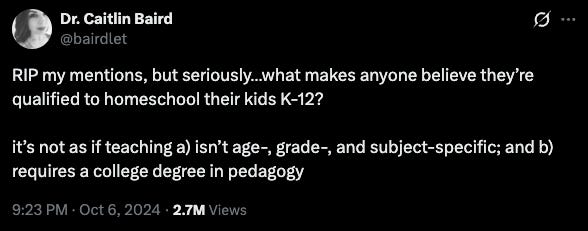
My mom homeschooled me and my younger sister in the 90s and early 2000s (my sister also decided to try public high school. She ended up salutatorian, #2 in her class, because she had an unexcused PE class absence). My mom was an English major. No teaching background or anything like that. The technology available at that time was literally stone age compared to what is available now. She would order curriculum guidebooks in the mail. There is so much more information and so many more tools at your disposal now than at any time before in history.
You don’t need to have a special degree to teach your kids. The only “qualification” you need to homeschool your kids is to love the heck out of them. Anyone who tells you differently is likely just a brainwashed product of the public school indoctrination system.
I’m not saying it will be easy, but I promise you it will be worth it.
“Homeschooled kids won’t learn as much as public school kids”
Give me a break. Anyone who has attended public school, which presumably is the vast majority of people reading this, knows this statement is complete bullshit.
After I stopped homeschooling and attended high school, I discovered that public school was absurdly easy, because everything caters to the lowest common denominator.
The goal is not to teach kids how to think, it is to indoctrinate them with what to think. The focus is on time spent (at your desk, doing homework, waiting quietly, etc.)—which trains kids to follow orders—instead of deliverables (get [X] done), which require agency and teach decision-making. That said, I had some really great science and math teachers in high school for whom I am still very grateful. They were also the type of teachers who thought administrative mandates were bullshit and just wanted to focus on teaching (they ended up getting reprimanded by the school admin a lot).
When you homeschool your kids, if you do it right, you have a chance to give them both a deeper and a broader education than is ever possible in a public school.
By the way, if public schools work, then why don’t they? Why do we see falling literacy rates in major public school districts all across the country? Why, despite more money than ever being spent on “education” are kids doing worse year after year?
Some mid-curve people claim it’s because we don’t spend enough money on education (i.e. “you should pay more taxes so we can indoctrinate your kids better”). But it’s not a problem of money. The system itself is simply broken.
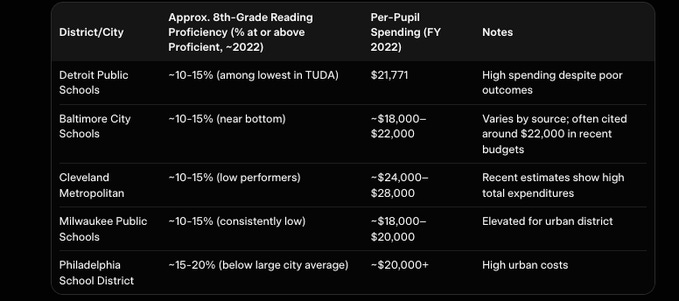
The chart below is a comparison of 8th-grade reading proficiency (percentage of students at or above NAEP Proficient level, based on 2022 Trial Urban District Assessment data from the Nation’s Report Card) and per-pupil spending (primarily FY 2022 figures from U.S. Census Bureau reports) in several of the lowest-performing large urban school districts in the United States.
Key districts highlighted include Detroit, Baltimore City, Cleveland, Milwaukee, and Philadelphia, which rank among the bottom performers in NAEP 8th-grade reading (with proficiency rates roughly in the 10-17% range, such as ~10% in Cleveland, ~17% in Philadelphia, and similarly low single-digit to low-teen percentages in Detroit, Baltimore, and Milwaukee—far below the national average of ~29-31% and large-city average of ~26%).
These districts spend significantly above the national average (~$15,633 per pupil in FY 2022), with figures often ranging from ~$18,000–$28,000 per student (e.g., Detroit at $21,771, Cleveland in the mid-to-high $20,000s, Baltimore and Philadelphia in the $18,000–$22,000+ range, and Milwaukee around $18,000–$20,000).
U.S. National Averages for Context:
-
8th-grade reading proficient: ~30% (2024, down from prior years)
-
Per-pupil spending: ~$15,633 (FY 2022)
Maybe if public schools spent less time trying to indoctrinate your kids with insane ideologies and more time focused on actual education then we wouldn’t have an ever-growing percentage of our nation’s youth who can’t even read...
“Homeschooling isn’t right for everyone”
This I actually agree with. Homeschooling is NOT right for everyone. But I am not speaking to everyone, I am speaking to YOU, dear reader, who cares enough to have read this far already.
The purpose of this article is not to convince every single person to homeschool their kids. It is to convince enough people to homeschool their kids so that the State does not have a monopoly on the future via education of the youth.
We don’t need everyone to homeschool their kids. But it is incumbent on those of us who do homeschool our kids to raise the next generation of leaders who can shape this world for the better.
The most important time to homeschool your kids is when they are the youngest. It is still important later on, but based on my own personal experience, the youngest years are the most crucial. That is when children are the most vulnerable and need the guidance of their parents and family. They do not need the guidance of the State.
It is insane to me that in most families both parents work, and they send their kid to childcare all day long, which costs them an arm and a leg. Then they send them to pre-school, then kindergarten, then elementary school, middle school, and high school... All the while, the child spends more waking time away from their parents than with their parents. Of course, much of this is a function of the fact that our money is fundamentally broken, and parents are forced to run forever on a fiat hamster wheel just to keep their heads above water.
But still, you can make choices. You have agency. You can choose to have one parent stay home and not work. I promise you that the small amount of extra money you make (after taxes and paying for someone else to raise your child) is not worth it. Take the income decrease, enjoy a lower tax bracket, save in bitcoin, and spend as much time with your kids as possible.
Remember: no one will ever love your kids or want what is best for them as much as you do.
Someone is going to indoctrinate your kids. Do you want it to be the State, or do you want it to be YOU?
I didn’t have time to get into all the particularly troublesome aspects of present-day public school indoctrination, like the types of insane ideologies that mentally ill teachers push on young children today... I think you can guess what I’m talking about. That’s a topic for a different article.
Personally, I refuse to abdicate responsibility for my children to the State.
Things I liked about homeschooling
-
I finished all my work in roughly two hours in the morning and spent the rest of the day outside. I was outside constantly.
-
I was done when I was done. There was no “homework” because it was all at home. Homework is just a tool the State uses to make sure that even when kids are back at home they are still occupied and don’t have time to learn from their parents.
-
I could do my work from anywhere, or work ahead a few days or weeks if needed. There were no arbitrary constraints.
-
It taught me to work on deliverables, how to teach myself new things, and how to work efficiently.
-
I read a shitload.
-
I was never uncomfortable around “adults.” They were just bigger people to me. I showed everyone respect, but I was perfectly comfortable and happy hanging out with adults even as the only kid (plus my sister).
-
I got to do a bunch of cool random shit because my schoolwork itself took very little time. I mentioned earlier when my mom set me up with a legit blacksmith to apprentice for a day. He’s the first person who taught me about Fibonacci. He was a seriously brilliant and badass dude. He made a huge impression on me and I will never forget it. I still have the knife I forged that day.
-
I played in the woods constantly. Started fires, built forts, and used knives and axes and guns from a young age. I hunted and fished with my dad, and learned how to grow food.
In terms of things I disliked, the only real thing was the worry that I was not going to be as smart as my peers at public school. Benchmarking was hard. It’s the whole reason I decided to go to high school, only to find out that a lot of people are complete morons with zero initiative, agency, drive, or grit. But perhaps they didn’t start out that way... Perhaps that’s just what happens when you are beaten down and broken by a public indoctrination system that aims to produce good little rule followers who won’t rock the boat too much...
You don’t have to do it alone
If you’re still worried about whether you can handle homeschooling your kids, just remember: you don’t have to do it alone. That’s what community is for.
I spent a day a week at a Montessori school for a few years. That was neat. Zero “schoolwork” was done. We just built shit and cooked shit and played outside.
My parents also helped found a small charter school with other local homeschoolers (about 10 kids of varying ages). We would get together once a week and had a couple tutors who came in.
I had an awesome Mennonite algebra tutor named Edith. We got on swell.
I guarantee there are other families in your community that homeschool or plan to homeschool. Find them and build your own community.
Additionally, as previously stated, there are infinitely more online resources available now than there were when my parents did it.
You have an incredible amount of tools at your disposal. All you need is the desire to use them.
Anyway, I highly recommend homeschooling, and will be doing it with our kid(s).
Homeschooling Trends
I have good news for you: homeschooling is on the rise, and at an increasing pace. Here are some quick stats on the current trajectory of homeschooling in the United States:
-
An estimated 3.4 million K-12 students were homeschooled in the U.S. during the 2024-2025 school year (range roughly 3.1–3.7 million), representing about 6.3% of the school-age population. This is roughly double pre-pandemic levels (around 2.5 million in 2019).
-
Homeschooling grew at an average rate of about 5.4% in 2024-2025—nearly triple the pre-pandemic annual growth rate of around 2%.
-
In many states, enrollment hit record highs in 2024-2025, even surpassing pandemic-era peaks, with 36% of reporting states at all-time highs. Growth varied widely (e.g., South Carolina at 21.5%, while some states saw minimal or no increase).
-
The post-pandemic surge has persisted rather than faded, driven by ongoing family preferences rather than temporary school disruptions.
Final Thoughts
I’ve said quite a lot already, but I’ll leave you with this...
We are about to enter one of the most tumultuous periods in history. Nations will rise and fall. Governments will crack down on their people more than ever before (you already see this happening globally). Statists will try to push compulsory public schooling even in places where it is currently legal, like America. We need to fight this at every turn.
One last thing. I’d like to thank my mom and my dad. You made sacrifices to give me and my sister what you knew was the best education and life possible, and I am eternally grateful. Which each passing year, I appreciate what you did for us more and more. Thank you.
If you read this far, thank you. You have a greater attention span than most. If you want to dig deeper into some of these topics I often discuss them on my podcast. Here are a couple episodes that may be of interest:
-
Sovereign Families: Bitcoin, Homeschooling, and Breaking the Fiat Cycle:
-
HOMESCHOOLING: SEPARATE EDUCATION & STATE:
-
Sound Parenting: How to Indoctrinate Your Kids Before Someone Else Does:
If you want to get new episodes delivered to your inbox, subscribe here