
The aim of this article is to explain the key problems Nostr solves for Geyser, and therefore outline its key properties. This article goes more in detail than the thread we wrote for our Nostr announcement in Nov-2024.
The Context
In the past year, we have keenly observed the developments taking place in Nostr. We then started enabling Nostr features like Login with Nostr, Nostr badges, and Zaps. These experiences, and the success of many Nostr projects on Geyser have strengthened our beliefs that:
-
Existing creator tools and crowdfunding lack interactive community experiences, which limit funding and potential success of projects.
-
Nostr is the ideal social network/protocol where to build an emergent platform like Geyser, thanks to content being interoperable across clients, its open social graph, and users owning their data.
Based on these experiences we decided to research the product value propositions of Nostr. The finding that follows outlines what we believe are the key problems Nostr solves, for platforms like Geyser. And explains our rationale for re-building the foundations of Geyser on top of Nostr.
Let’s look at what problems creators are experiencing today and how we plan to solve them.
The Problem of Closed Databases
Although “crowdfunding” combines “crowd” and “funding,” existing platforms focus on the fundraising aspect and lack any form of social engagement. The content created created and social interactions revolving around fundraising projects takes place on social networks where can go viral. It follows that if these interactions aren’t happening on fundraising platforms, that’s not where the “crowds” are.
This segregation of the "social" from the "funding" aspects of crowdfunding places barriers on the growth of creators, their communities, and the funding towards their projects.
From interacting extensively with our users, it become clear to us that creators long for greater connection with their contributors. We heard things like: “being a creator is a lonely experience", “how do I keep chats ignited, keep people excited about my project?” and "how can Geyser enhance my reach?". All this made evident the an opportunity of making Geyser not only the place where funding takes place but where social engagement within the project can thrive.
Creator platforms like Patreon, Onlyfans, Ko-fi, BuyMeaCoffee and Substack have all realized he role of creator-member interaction and engagement. They tried to replicate Twitter's online social engagement model with posts, replies, feeds, retweets, etc. But these solutions are built on closed databases, where information can't flow beyond the platforms and therefore minimize creator reach and impact.
As a result, they drastically limit the interaction around creators’ projects and, most importantly, the potential reach of their content - which is ultimately what they are after.
So, the question is: what type of databases can maximise the social engagement for creators and extend their reach?
The problem of Closed Social Graphs
A social graph is a way of visualizing users’ relationships to their followers. When each platform creates a new profile for every new user, they start creating the user’s social graph from scratch. As a result, platforms have limited knowledge about new users and miss on changes in that user’s social graphs taking place on other platforms.
This means that platforms:
- Can’t make relevant recommendations about users to befriend or content to follow, or projects they find relevant, because all the user's information is owned by the social network.
- Can’t accurately assess a user’s reliability and trust. This is particularly a problem for fundraising platforms, who can’t assess users’ intents or veracity.
- Can’t enable certain interactions with users’ existing social graphs beyond that particular platform.
So, due to proprietary and closed social graphs, fundraising platforms are limited in their ability of providing and unlocking value for their users. For example, at Geyser we are in the dark about users who log in with Twitter: their history, network, and social trust are Twitter’s domain, shielded by a $42k/month paywall. We are required to compete with Twitter social's graph by re-building from scratch the social graph for each users.
Fundraising is intricately tied to our social networks and social history. And a lack of this visibility limits our ability to provide valuable tools and experiences to our users.
The Problem of Censorship
When a platform censors a user or his content, they are censoring speech and deleting users with all their history of activity without requiring permission to do so. This is because the data is owned by the platform, not the user.
We don’t need to go in detail here on why censorship and self-censorship are bad. But the broader issue here is that removing someone from a platform shouldn’t involve taking away one’s hard work on the platform.
Importantly, the platform that owns of the social graph can also censor other platforms! Remember the Substack-Twitter saga? Substack was building its social networking capability by gathering user's Twitter data, via the Twitter APIs. Once Twitter discovered this, they banned Substack from accessing social graph data via their APIs (introducing a $45k monthly paywall), started censoring Substack links, and charging for basic OAuth - which led all Substack users who typically logged in via Twitter OAuth to not be able to log into Substack!
This is what happens when a social network ends up monopolizing the social graph. Social graphs should be an open property of the network, and not control by any one party
The Solution
At Geyser we believe social engagement surrounding a project is foundational to the success of a creator's project. So, how do we build social engagement on our platform without building yet another walled garden that does not serve the creators and contributors?
Building social engagement in a walled garden in the traditional way of Patreon, Substack & Co would close creators' ability to reach more people with the content they create, it would block them off from their existing social graph, and would leave us and our creators vulnerable to different forms of censorship.
Why build these social features in an island, where they can be built in an existing, growing, open social network with its own existing social graph like Nostr?
This is why Geyser is integrating with Nostr. Doing so will enable content and interactions to exist cross-platform. This will unlock a lot of value for creators and their contributors, and increase funding going to projects as a result.
1. Nostr's open database model allows creators to reach their followers Content that is created on Geyser is directly accessible across Nostr. And if content can exist openly, then all resulting social interactions (replies, etc) and contributions (Zaps) can also take place from other Nostr clients while benefiting Geyser through incoming transactions.
Everything related to a project–contributions, short posts, long-form articles, reward purchases, chatrooms, the crowdfunding goals, voice channels, and potentially much more–will be interoperable with the wider Nostr ecosystem.
This will expand drastically the surface area of the projects, and allow communities to more easily access, interact with, and contribute to project content directly from other Nostr clients.
2. Nostr allows us to connect users with other relevant users and content While all social networks have locked us out of their graphs, the best and only solution is to connect to an open, permissionless social graph that is Nostr. We can do this by baking every Geyser project into a Nostr npub, which can connect to the existing social graph of Nostr.
This will allow us to recognize social proof our users have accrued, minimize the impact of spammers and impersonators, showcase more relevant content based on user's social graph.
By connecting to the Nostr social graph, we transform Geyser from a lonely island to an interconnected super-highway. It’s through this interconnection of people that great ideas can take off!
- Ensuring censorship resistance We plan to start by giving users the ability to choose whether to take their project and content elsewhere.
Looking forward, we think digital identities must be decentralized and not owned by any platform. That’s why we’ll enable non-custodial projects on Geyser, which will enable users to fully own their data and resist de-platforming.
And Geyser itself runs no risk of being cut off from Nostr, wheres we do with Twitter. We can build on a secure, open, non-proprietary system, where we can reap the benefits of network effects and social graphs growing through time.
The use of protocols like Nostr helps us unlock value for creators beyond what current social and crowdfunding platforms do. In doing so, we are paving the way for the creation of a new paradigm for the creator's web, which we call the Open Creator Economy
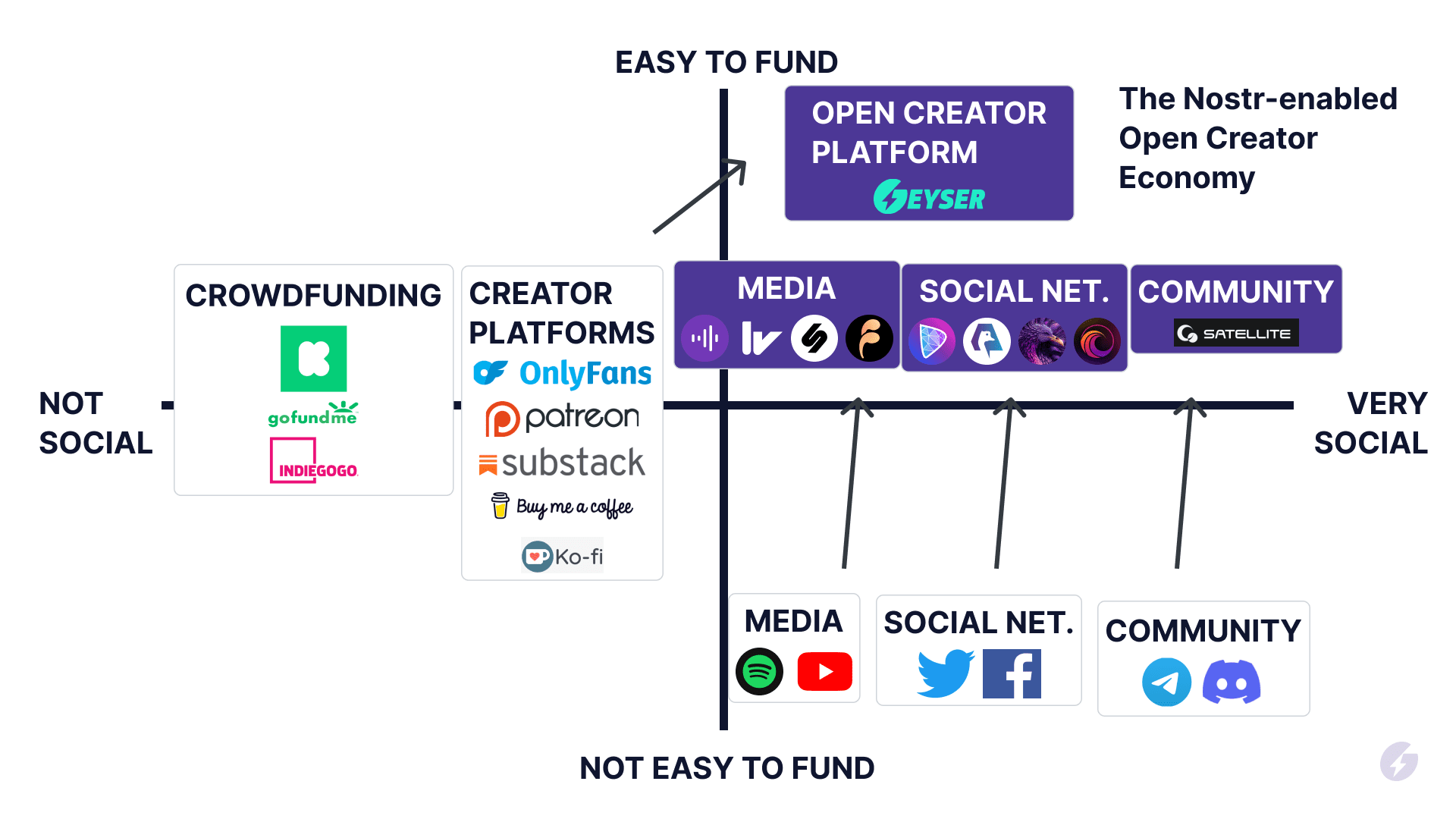
The announcement on Nostr:
The announcement on Twitter: x.com/geyserfund/status/1721451136241316016?s=20