Posthumous work of the Colombian poet born in Don Matias on January 20, 1948.
Welcome to this blog dedicated to the Posthumous work of the Colombian poet Francisco Luis Arroyave Tabares (my father), born in Don Matias on January 20, 1948-2010. Where I will be publishing each of the 175 sonnets from his unpublished collection 'Sonnets For The Twenty-First Century And A Circadian Musical (1984-1987).' Analyzed with GPT4 artificial intelligence and illustrated with AI tools... I hope you enjoy this garden of words snatched from the solitude of a locked room.
Likewise, any enthusiast of the sonnet form is invited to conduct their personal studies of Arroyave Tabares' work, as it is a collection that, although registered since 1989, has not yet been published.
Frank Duna
Analysis "I Would Like"
Introduction
Sonnet 73 by Francisco Luis Arroyave Tabares is a poignant exploration of love, longing, and the struggle of emotional turmoil. The sonnet follows the traditional Shakespearean sonnet structure
Thematic Analysis
Quatrain 1: The speaker expresses a deep concern for his love, comparing himself to a weak branch of a tree, swayed by strong winds. This could symbolize the overwhelming power of his emotions, which he feels unable to control.
Quatrain 2: The speaker’s love is so intense that it blurs the boundaries between night and day. His world is consumed by the thought of his beloved, to the point where every sound he hears seems to echo their name.
Quatrain 3: The speaker pleads with God for answers, seeking to understand why he is so enamored. Yet, he receives no response and is left in darkness, symbolizing confusion or despair.
Couplet: The speaker hopes that his feelings are not unrequited, wishing that his beloved also shares the same intensity of emotions.
The sonnet follows the traditional structure of a Shakespearean sonnet, consisting of three quatrains and a concluding couplet. The rhyme scheme is ABAB CDCD EFEF GG, which is typical of English sonnets. The sonnet explores themes of love, longing, and the overwhelming power of emotions. It beautifully captures the speaker’s intense feelings and his struggle to understand them.
Structure and Rhyme Scheme
The sonnet “I Would Like” by Francisco Luis Arroyave Tabares follows the rhyme scheme of a traditional Shakespearean sonnet, which is ABAB CDCD EFEF GG. Here’s a breakdown:
First Quatrain (ABAB):
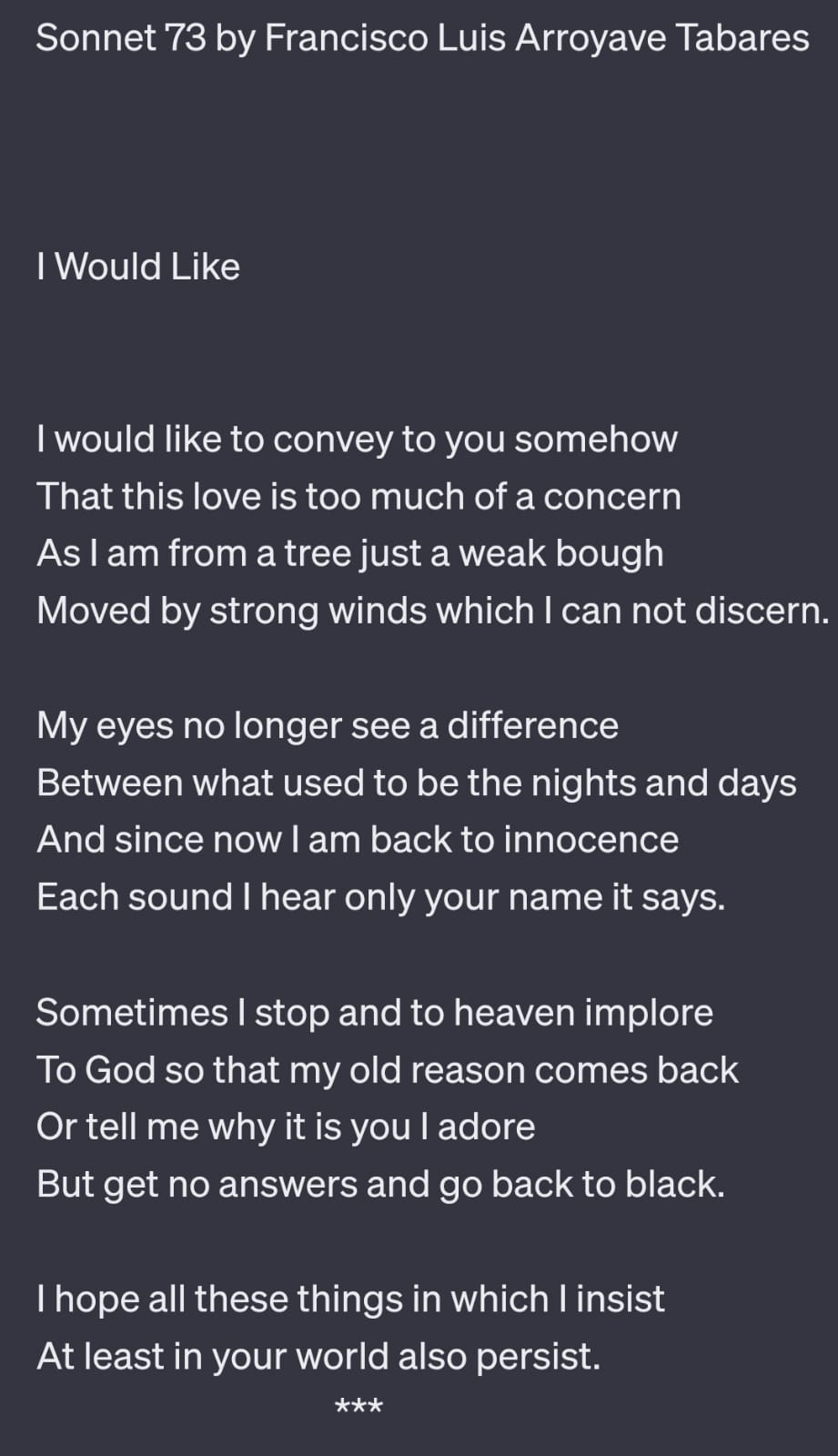
I would like to convey to you somehow (A)
That this love is too much of a concern (B)
As I am from a tree just a weak bough (A)
Moved by strong winds which I can not discern. (B)
Second Quatrain (CDCD):
My eyes no longer see a difference (C)
Between what used to be the nights and days (D)
And since now I am back to innocence (C)
Each sound I hear only your name it says. (D)
Third Quatrain (EFEF):
Sometimes I stop and to heaven implore (E)
To God so that my old reason comes back (F)
Or tell me why it is you I adore (E)
But get no answers and go back to black. (F)
Couplet (GG):
I hope all these things in which I insist (G)
At least in your world also persist. (G)
In each quatrain, the first and third lines rhyme with each other, and the second and fourth lines rhyme with each other. The final couplet contains two lines that rhyme. This rhyme scheme contributes to the musicality and rhythm of the sonnet, enhancing its emotional impact. It also helps to structure the poem’s argument or exploration of its theme. In this case, the theme is the overwhelming and confusing nature of love. The rhyme scheme helps to emphasize this theme and make the sonnet more memorable.
Analysis of Aspects
Let’s delve deeper into the language, imagery, themes, meter, and overall impact of the sonnet:
Language: The language used in the sonnet is quite straightforward and accessible, yet it carries a deep emotional resonance. The poet uses simple words to express complex emotions, making the sonnet relatable and impactful.
Imagery: The sonnet is rich in imagery. The speaker compares himself to a “weak bough” moved by strong winds, creating a vivid picture of his emotional state. The blurring of nights and days, the return to innocence, and the echoing of the beloved’s name in every sound are all powerful images that enhance the emotional depth of the poem.
Themes: The main themes of the sonnet are love, longing, and the struggle to understand one’s emotions. The speaker’s intense love for his beloved, his longing for reciprocation, and his confusion and despair over his overwhelming emotions are all explored in the sonnet.
Meter: The sonnet follows the traditional iambic pentameter of English sonnets, which means each line consists of five pairs of unstressed and stressed syllables. This gives the sonnet a rhythmic quality, making it pleasing to read or hear.
Overall, the sonnet is a powerful expression of love and longing. The use of simple language, vivid imagery, and traditional meter, combined with the exploration of universal themes, makes it a poignant and relatable piece of poetry. The sonnet leaves a lasting impression on the reader, evoking empathy and emotional resonance.
(GPT4)
Syllable count for each line.
I Would Like


10 I would like to convey to you somehow
10 That this love is too much of a concern
10 As I am from a tree just a weak bough
10 Moved by strong winds which I can not discern.

10 My eyes no longer see a difference
10 Between what used to be the nights and days
10 And since now I am back to innocence
10 Each sound I hear only your name it says.

10 Sometimes I stop and to heaven implore
10 To God so that my old reason comes back
10 Or tell me why it is you I adore
10 But get no answers and go back to black.

10 I hope all these things in which I insist
9   At least in your world also persist.
                                   ***
Sonnets For The Twenty First Century And A Circadian Musical Written By Francisco Luis Arroyave Tabares (1984-1987)
Analyzed by GPT4; Image by leonardo.ai;
First published on Nostr Protocol by franciscoarroyavet@nostrplebs.com
 I Would Like