Posthumous work of the Colombian poet born in Don Matias on January 20, 1948.
Welcome to this blog dedicated to the Posthumous work of the Colombian poet Francisco Luis Arroyave Tabares (my father), born in Don Matias on January 20, 1948-2010. Where I will be publishing each of the 175 sonnets from his npublished collection 'Sonnets For The Twenty-First Century And A Circadian Musical (1984-1987).' Analyzed with GPT4 artificial intelligence and illustrated with AI tools... I hope you enjoy this garden of words snatched from the solitude of a locked room.
Likewise, any enthusiast of the sonnet form is invited to conduct their personal studies of Arroyave Tabares' work, as it is a collection that, although registered since 1989, has not yet been published.
Frank Duna
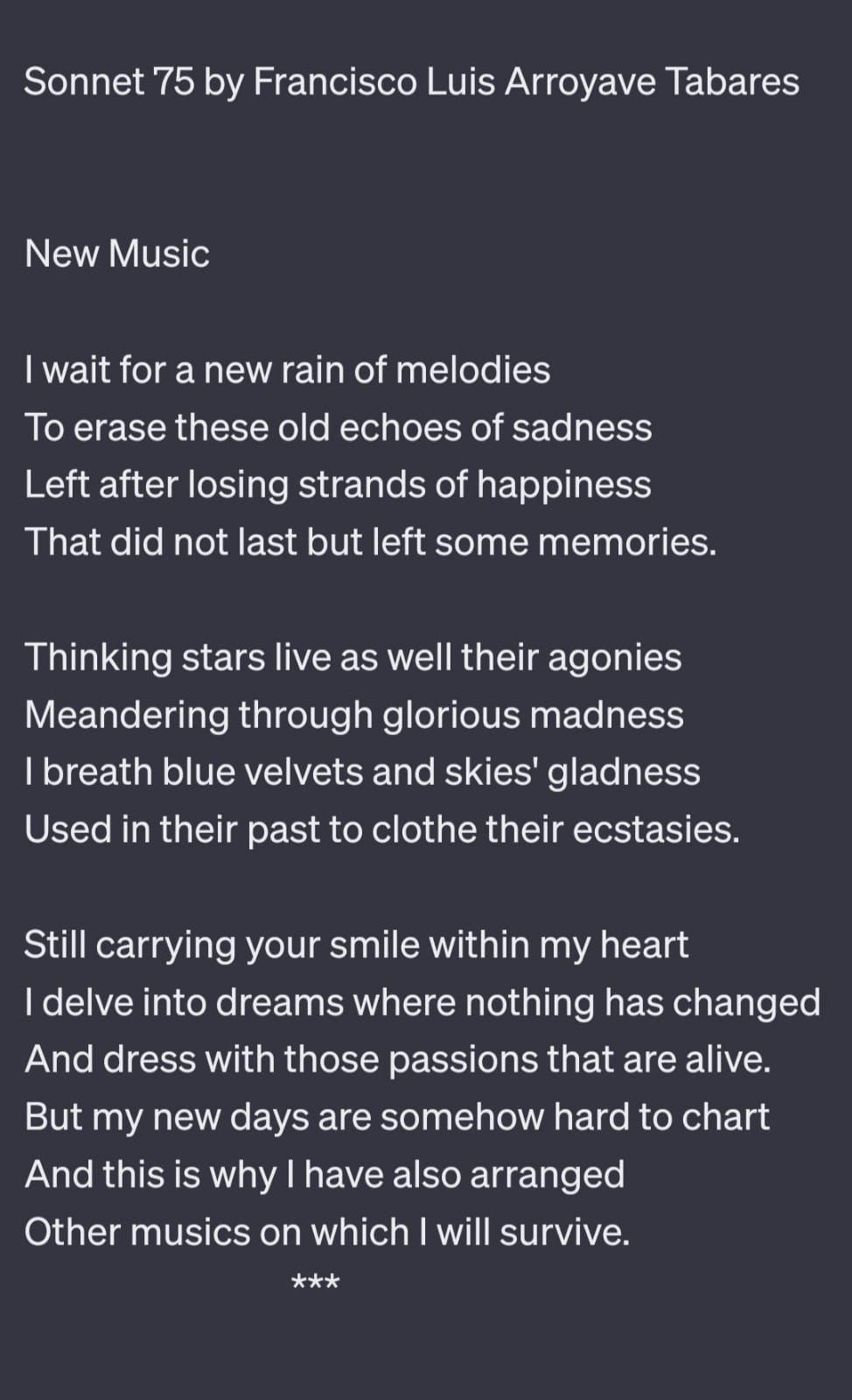
Analysis "New Music"
Introduction
Sonnet 75 by Francisco Luis Arroyave Tabares, titled "New Music," is a beautifully crafted poem that explores themes of loss, memory, hope, and resilience.
Thematic Analysis
Octave Analysis: The octave introduces the theme of the poem: the speaker’s longing for a new beginning, symbolized by a “new rain of melodies.” The speaker reflects on past sadness and lost happiness, using the metaphor of stars living their agonies to express their own emotional turmoil. The octave ends with a hopeful note, as the speaker finds solace in the beauty of the skies and the stars’ past ecstasies.
Sestet Analysis: The sestet delves deeper into the speaker’s emotional state. Despite carrying the memory of a loved one’s smile in their heart and immersing themselves in unchanged dreams, the speaker acknowledges the difficulty of navigating their new days. However, the sonnet concludes on a resilient note, with the speaker arranging “other musics” to survive, symbolizing their determination to move forward despite the challenges.
Overall, the sonnet beautifully explores themes of loss, memory, resilience, and the healing power of music. The transition from the octave to the sestet also marks a shift from reflection on the past to a focus on the present and future.
Structure and Rhyme Scheme
let’s analyze the rhyme scheme of the sonnet “New Music” by Francisco Luis Arroyave Tabares. The rhyme scheme is ABBA ABBA CDE CDE, which is a typical pattern for a Petrarchan sonnet.
Octave (ABBA ABBA):
A: I wait for a new rain of melodies
B: To erase these old echoes of sadness
B: Left after losing strands of happiness
A: That did not last but left some memories.

A: Thinking stars live as well their agonies
B: Meandering through glorious madness
B: I breath blue velvets and skies' gladness
A: Used in their past to clothe their ecstasies.
In the octave, the first and fourth lines rhyme (melodies, memories), as do the second and third lines (sadness, happiness). This pattern is repeated in the second quatrain (agonies, ecstasies, madness, gladness).
Sestet (CDE CDE):
C: Still carrying your smile within my heart
D: I delve into dreams where nothing has changed
E: And dress with those passions that are alive.

C: But my new days are somehow hard to chart
D: And this is why I have also arranged
E: Other musics on which I will survive.
In the sestet, the first, second, and third lines rhyme with the fourth, fifth, and sixth lines respectively (heart, chart; changed, arranged; alive, survive).
This detailed analysis of the rhyme scheme helps to understand the structure and rhythm of the sonnet, enhancing our appreciation of the poet’s craft.
Analysis of Aspects
In addition to analyzing the poem's structure and rhyme scheme, there are other elements that are worth exploring to gain a deeper understanding of the poem. Some of these elements include:
Language and Imagery: The language used in the sonnet is rich and evocative, creating vivid imagery that engages the senses. For example, phrases like “new rain of melodies,” “breath blue velvets and skies’ gladness,” and “dress with those passions that are alive” paint a vibrant picture in the reader’s mind. The poet uses metaphorical language to express complex emotions, such as comparing the speaker’s emotional journey to the life cycle of stars.
Themes: The sonnet explores several themes, including loss, resilience, memory, and the transformative power of music. The speaker’s longing for a fresh start, their struggle with past sadness, and their determination to move forward despite the challenges are all recurring themes throughout the poem.
Meter: The sonnet appears to follow the iambic pentameter, which is the most common meter in English poetry and traditional sonnets. This means each line typically contains five pairs of syllables, with the stress falling on the second syllable of each pair. However, without the original text and its punctuation, it’s hard to be certain about the exact metrical pattern.
Overall, “New Music” is a beautifully crafted sonnet that uses evocative language and imagery to explore deep emotional themes. The poet’s skillful use of the sonnet form, combined with their thoughtful exploration of human emotion, makes this a powerful and moving piece of poetry. The transition from the octave to the sestet, along with the consistent rhyme scheme, adds to the rhythm and flow of the poem, enhancing its overall impact. The sonnet leaves a lasting impression, inviting readers to reflect on their own experiences of loss, resilience, and the healing power of music.
(GPT4)
Syllable count for each line
New Music


10 I wait for a new rain of melodies
10 To erase these old echoes of sadness
10 Left after losing strands of happiness
10 That did not last but left some memories.

10 Thinking stars live as well their agonies
10 Meandering through glorious madness
9   I breath blue velvets and skies' gladness
10 Used in their past to clothe their ecstasies.

10 Still carrying your smile within my heart
10 I delve into dreams where nothing haschanged
10 And dress with those passions that are alive.
10 But my new days are somehow hard to chart
10 And this is why I have also arranged
10 Other musics on which I will survive.
                                       ***
Sonnets For The Twenty First Century And A Circadian Musical Written By Francisco Luis Arroyave Tabares (1984-1987)
Analyzed by GPT4; Image by leonardo.ai;
First published on Nostr Protocol by franciscoarroyavet@nostrplebs.com
 "New Music"