Posthumous work of the Colombian poet born in Don Matias on January 20, 1948.
Welcome to this blog dedicated to the Posthumous work of the Colombian poet Francisco Luis Arroyave Tabares (my father), born in Don Matias on January 20, 1948-2010. Where I will be publishing each of the 175 sonnets from his npublished collection 'Sonnets For The Twenty-First Century And A Circadian Musical (1984-1987).' Analyzed with GPT4 artificial intelligence and illustrated with AI tools... I hope you enjoy this garden of words snatched from the solitude of a locked room.
Likewise, any enthusiast of the sonnet form is invited to conduct their personal studies of Arroyave Tabares' work, as it is a collection that, although registered since 1989, has not yet been published.
Frank Duna
Analysis "Our Truth"
Introduction
Sonnet 74 by Francisco Luis Arroyave Tabares is a poignant exploration of love, longing, and the passage of time.
Thematic Analysis
In the octave, the speaker expresses a deep longing for the beloved, symbolized through the metaphor of casting a heart “upon a breast of wind”. The beloved’s name is described as a wine that ages with their fame, suggesting a growing, maturing love. The speaker also mentions the pain of their absence and the precious memory of their last kiss.
The sestet shifts the focus to the speaker’s dreams where they can still see the beloved. There’s a sense of struggle against the harsh rules of destiny and a critique of fate as being a source of abuses. The sonnet concludes with a powerful image of fate as just foam in the streams of torrid passions, suggesting that the truth of their love is more potent and enduring than the whims of fate.
Overall, the sonnet beautifully captures the themes of longing, the passage of time, the power of dreams, and the enduring truth of love. It’s a poignant exploration of love’s triumph over the trials of time and fate.
Rhyme Scheme Analysis
The sonnet “Our Truth” by Francisco Luis Arroyave Tabares follows the rhyme scheme ABBA ABBA CDC DCD. Here’s how it works:
Octave (first eight lines):
Lines 1 and 4 (“near” and “tear”) rhyme with each other, forming the ‘A’ rhyme.
Lines 2 and 3 (“name” and “fame”) rhyme with each other, forming the ‘B’ rhyme.
Lines 5 and 8 (“clear” and “dear”) rhyme with each other, forming the ‘A’ rhyme.
Lines 6 and 7 (“frame” and “came”) rhyme with each other, forming the ‘B’ rhyme.
So, the rhyme scheme for the octave is ABBA ABBA.
Sestet (last six lines):
Lines 9 and 11 (“dreams” and “deems”) rhyme with each other, forming the ‘C’ rhyme.
Lines 10 and 12 (“refuses” and “abuses”) rhyme with each other, forming the ‘D’ rhyme.
Lines 13 and 14 (“streams” and “uses”) rhyme with each other, forming the ‘C’ rhyme.
So, the rhyme scheme for the sestet is CDC DCD.
This rhyme scheme is a variant of the Petrarchan sonnet form, which typically has an ABBA ABBA octave, but can vary in the sestet. It’s a complex structure that adds to the musicality and rhythm of the poem. The shift in rhyme scheme from the octave to the sestet often accompanies a shift in theme or tone, as we see in this sonnet. The octave focuses on the speaker’s longing and memory of the beloved, while the sestet shifts to dreams, fate, and the enduring truth of their love. The change in rhyme scheme underscores this thematic shift.
Additional Aspects of Analysis
While we've covered the rhyme scheme and thematic content of Sonnet 74 by Francisco Luis Arroyave Tabares, there are still several aspects that can be further analyzed.
Language and Imagery: The language used in “Our Truth” is rich and evocative, with a strong use of metaphor and simile. The poet uses the image of casting a heart “upon a breast of wind” to convey the feeling of longing and distance. The beloved’s name is likened to a wine that matures with their fame, suggesting a deep and growing love. The imagery of the sunset adding more gold to the frame that holds the beloved’s picture is a beautiful metaphor for memory and the passage of time.
Themes: The main themes of the sonnet are love, longing, the passage of time, and the power of dreams. The speaker expresses a deep longing for the beloved and reflects on the pain of their absence. The theme of dreams is introduced in the sestet, where the speaker finds solace in the dreams of the beloved. The sonnet also explores the theme of fate and destiny, critiquing their harsh rules and abuses.
Meter: The sonnet follows the traditional iambic pentameter, which is a line of verse with five metrical feet, each consisting of one short (or unstressed) syllable followed by one long (or stressed) syllable. This gives the poem a rhythmic flow and musicality.
Overall, “Our Truth” is a beautifully crafted sonnet that explores the themes of love, longing, dreams, and fate through rich language and evocative imagery. The use of the traditional sonnet form, with its specific rhyme scheme and meter, adds to the poem’s musicality and rhythm. The shift in theme from the octave to the sestet, marked by the change in rhyme scheme, effectively underscores the emotional journey of the speaker from longing and memory to dreams and the enduring truth of love. It’s a poignant exploration of love’s triumph over the trials of time and fate.
GPT4
Syllable count for each line
Our Truth


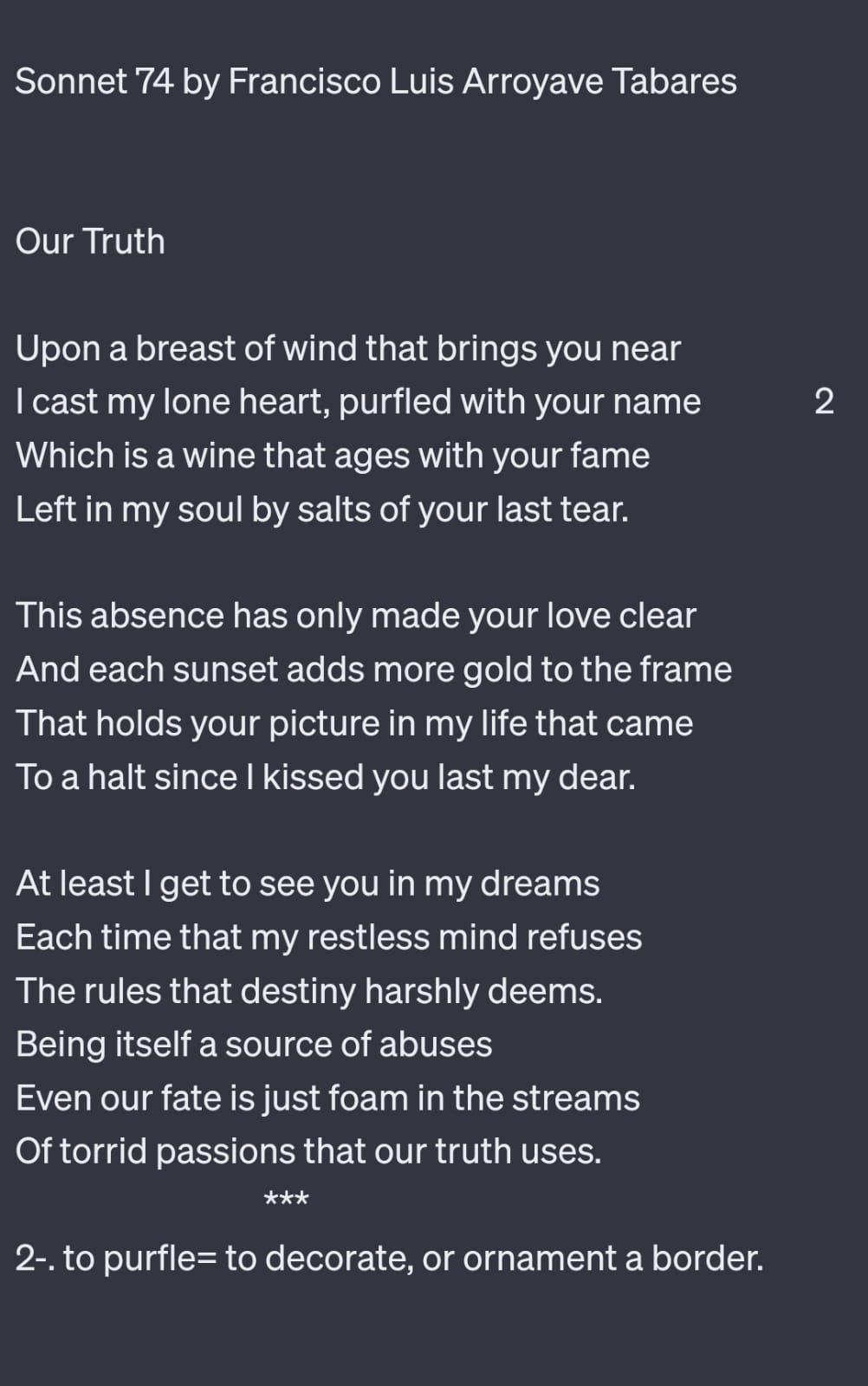
10 Upon a breast of wind that brings you near

10 I cast my lone heart, purfled with your name

10 Which is a wine that ages with your fame

10 Left in my soul by salts of your last tear.


10 This absence has only made your love clear

10 And each sunset adds more gold to the frame

10 That holds your picture in my life that came

10 To a halt since I kissed you last my dear.


10 At least I get to see you in my dreams

10 Each time that my restless mind refuses

9   The rules that destiny harshly deems.

10 Being itself a source of abuses

10 Even our fate is just foam in the streams

10 Of torrid passions that our truth uses.

                            ***
Sonnets For The Twenty First Century And A Circadian Musical Written By Francisco Luis Arroyave Tabares (1984-1987)
Analyzed by GPT4; Image by leonardo.ai; First published on Nostr Protocol by franciscoarroyavet@nostrplebs.com
 Our Truth