Posthumous work of the Colombian poet born in Don Matias on January 20, 1948.
Welcome to this blog dedicated to the Posthumous work of the Colombian poet Francisco Luis Arroyave Tabares (my father), born in Don Matias on January 20, 1948-2010. Where I will be publishing each of the 175 sonnets from his npublished collection 'Sonnets For The Twenty-First Century And A Circadian Musical (1984-1987).' Analyzed with GPT4 artificial intelligence and illustrated with AI tools... I hope you enjoy this garden of words snatched from the solitude of a locked room.
Likewise, any enthusiast of the sonnet form is invited to conduct their personal studies of Arroyave Tabares' work, as it is a collection that, although registered since 1989, has not yet been published.
Frank Duna
Analysis "With Just A Glance"
Introduction:
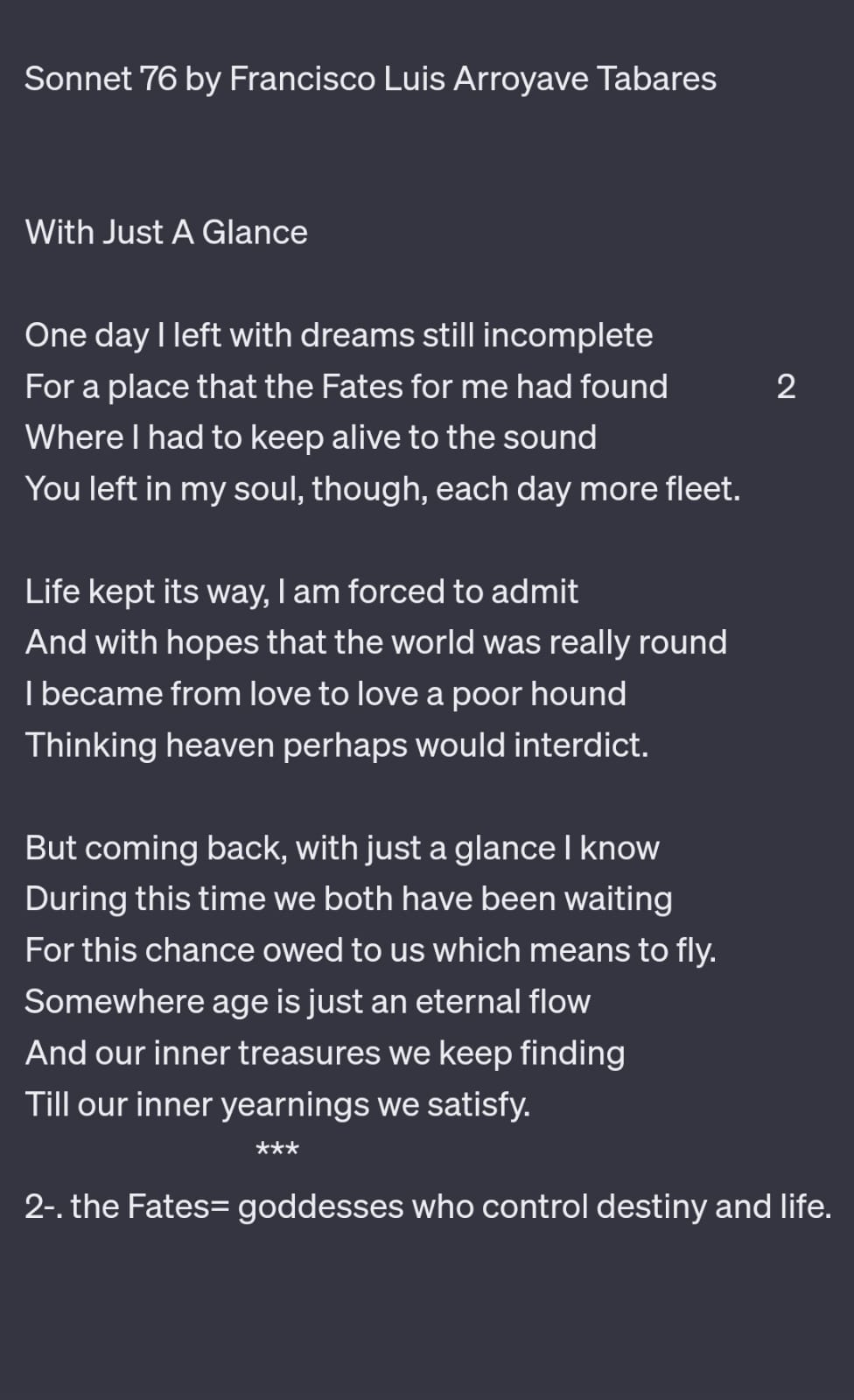
Sonnet 76 by Francisco Luis Arroyave Tabares, titled "With Just A Glance," is a beautiful exploration of longing, time, and the transformative power of love.
Thematic Analysis
Octave Analysis: The octave presents a narrative, proposition, or problem. In this case, it tells the story of the speaker leaving a place with incomplete dreams, driven by the sound left in his soul. The speaker admits that life continued, and he moved from one love to another, hoping for divine intervention.
Sestet Analysis: The sestet usually responds to or resolves the octave’s narrative or problem. Here, the speaker returns and realizes that both he and the unnamed other have been waiting for a chance to fly. The speaker suggests that age is an eternal flow where we continue to discover our inner treasures until we satisfy our inner yearnings.
This sonnet beautifully explores themes of time, love, longing, and self-discovery. The transition from the octave to the sestet also marks a shift from a sense of loss and longing to a more hopeful and introspective tone. The speaker’s journey from leaving with incomplete dreams to finding inner treasures signifies personal growth and self-realization. The sonnet ends on a hopeful note, suggesting that our inner yearnings can be satisfied as we continue to discover our inner treasures.
Rhyme Scheme:
The rhyme scheme , ABBA ABBA CDE CDE, is a common one for sonnets, particularly those in the Petrarchan or Italian style. Let’s analyze how this scheme applies to the sonnet “With Just A Glance” by Francisco Luis Arroyave Tabares:
Octave:
One day I left with dreams still incomplete (A)
For a place that the Fates for me had found (B)
Where I had to keep alive to the sound (B)
You left in my soul, though, each day more fleet. (A)
Life kept its way, I am forced to admit (A)
And with hopes that the world was really round (B)
I became from love to love a poor hound (B)
Thinking heaven perhaps would interdict. (A)
**Sestet: **
But coming back, with just a glance I know (C)
During this time we both have been waiting (D)
For this chance owed to us which means to fly. (E)
1Somewhere age is just an eternal flow (C)
1And our inner treasures we keep finding (D)
Till our inner yearnings we satisfy. (E)
In the octave, the first and fourth lines rhyme, as do the second and third lines, creating an ABBA pattern. This pattern is repeated in the next four lines. In the sestet, the ninth and twelfth lines rhyme (C), as do the tenth and thirteenth lines (D), and the eleventh and fourteenth lines (E), creating a CDE CDE pattern. This rhyme scheme contributes to the sonnet’s rhythm and musicality, while also helping to delineate the shift in tone and content between the octave and the sestet.
Additional Aspects to Analyze
Language and Imagery: The language used in the sonnet is rich and evocative, with a strong use of imagery. The speaker uses metaphors such as “dreams still incomplete”, “keep alive to the sound”, and “from love to love a poor hound” to express his longing and journey. The phrase “age is just an eternal flow” is a powerful image that conveys the concept of time’s relentless passage.
Themes: The sonnet explores several themes, including love, longing, time, self-discovery, and personal growth. The speaker’s journey from leaving with incomplete dreams to finding inner treasures signifies personal growth and self-realization. The theme of time is also prominent, with the speaker reflecting on the passage of time and its impact on our lives and relationships.
Meter: The sonnet appears to follow the iambic pentameter, which is a common meter in English poetry and particularly in sonnets. This means each line typically contains five pairs of syllables, or iambs, where the first syllable is unstressed and the second is stressed.
Overall, the sonnet is a beautifully crafted piece of poetry that uses evocative language and imagery to explore deep and universal themes. The structure of the sonnet, with its octave and sestet, allows for a narrative progression and a shift in tone that adds depth to the poem. The use of the ABBA ABBA CDE CDE rhyme scheme contributes to the sonnet’s rhythm and musicality, while also helping to delineate the shift in tone and content between the octave and the sestet. The sonnet ends on a hopeful note, suggesting that our inner yearnings can be satisfied as we continue to discover our inner treasures. This leaves the reader with a sense of optimism and the belief in the possibility of personal growth and self-realization.
(GPT4)
Syllable count for each line
 With Just A Glance


10 One day I left with dreams still incomplete

10 For a place that the Fates for me had found

10 Where I had to keep alive to the sound

10 You left in my soul, though, each day more fleet.


10 Life kept its way, I am forced to admit

10 And with hopes that the world was really round

10 I became from love to love a poor hound

10 Thinking heaven perhaps would interdict.


10 But coming back, with just a glance I know

10 During this time we both have been waiting

10 For this chance owed to us which means to fly.

10 Somewhere age is just an eternal flow

10 And our inner treasures we keep finding

10 Till our inner yearnings we satisfy.
Sonnets For The Twenty First Century And A Circadian Musical Written By Francisco Luis Arroyave Tabares (1984-1987)
Analyzed by GPT4; Image by leonardo.ai;
First published on Nostr Protocol by franciscoarroyavet@nostrplebs.com
 With Just A Glance